Cisco Networking Academy
Learn the technology, land your dream job. Ready to begin, change, or propel your career? Cisco Networking Academy offers certification-aligned courses in topics like cybersecurity, networking, and Python.
The American Indian Policy Institute is home to the newly formed Center for Tribal Digital Sovereignty, formed in partnership with the National Congress of American Indians. This Center is the first and only one in the nation dedicated to helping tribal governments, leadership, and communities understand the complexities of digital sovereignty. It provides access to resources and serves as a clearinghouse for tribal digital sovereignty. The center works towards the following goals and concepts: scholarship, capacity building, policy research and advocacy, and forming a coalition of organizations that work together to support tribes.
Through ARPA Funding, the goal is to connect every Yavapai County residence, business, and community anchor institution with high-speed internet. Read more about how Yavapai County Board of Supervisors approved $16,883,047 in American Rescue Plan Act (ARPA) funds to provide access to high-speed Internet to 13,794 locations across Yavapai County.
The Telecommunications Education Center [TEC] is a dynamic learning program devoted to improving education, quality of work, and safety within the telecommunications industry created by the world’s leading authority on all things wireless, the Wireless Infrastructure Association.
TIRAP is a federally recognized, competency-based apprenticeship program. WIA is the DOL’s designated Industry Intermediary for Registered Apprenticeship in the telecommunications industry. Through TIRAP, WIA provides technical assistance, training resources, support, and access to incentive funding for our registered Employer Sponsors.
WIA specializes in working with government, education, and industry stakeholders to develop workforce solutions for the broadband industry. We are a hub for broadband workforce training and apprenticeship resources.
The Arizona Memory Project (AMP) helps researchers discover information related to the history and government of Arizona by providing access to primary sources in Arizona archives, museums, libraries, and other cultural institutions
Lending Library: including audio books and magazines; movies with audio descriptions; and Braille books and magazines by postage free mail (KLAS); loan of special equipment to play audio books; audio and Braille book downloads (BARD); and access to NFB-NEWSLINE® and over 300 newspapers and magazines by phone and online
June 18, 2024
Phoenix’s plan, if approved, would add a new section to the city code to provide the rules for licensing and transactions between the city and companies who build and operate fiber-optic networks.
Jun 14, 2023
The Biden administration on June 12 announced it will send $714 million to help rural areas in 19 states connect to the internet, including $25 million for the Colorado River Indian Tribes.
June 6, 2024
The world has increasingly become more digital. From remote work to online education programs and even telehealth services, our interactions are highly enabled by technology. However, this isn’t a reality for all…yet. Take, for example, a retiree who needs to schedule a doctor's appointment but does not know how to access their provider’s website portal. Or a family whose device isn’t working properly and restricting access to internet services that many of us use to work, learn and live online.
The Arizona Telecommunications and Information Council (ATIC) is a non-profit organization of business, government, academic, and other relevant participants that provides expertise to effectively guide telecommunications and digital technology policy development and deployment in the state of Arizona and serves as a leading source of expertise on broadband technology matters.
This Application was created to help with permitting planning and environmental review preparation efforts by providing access to multiple maps from publicly available sources, including federal review, permitting, and resource agencies, as well as information about infrastructure and right of way.
The Center on Rural Innovation (CORI) has created a suite of BEAD application resources and an interactive mapping tool to help smaller ISPs be more competitive when applying for this historic funding.
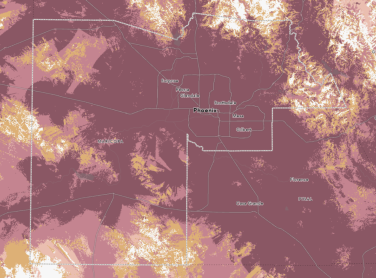
This map from The Center on Rural Innovation (CORI) allows potential BEAD applicants to explore eligible project areas, view project areas funded by previous federal grants, and easily see existing ISP footprints in potential deployment areas. The tool is designed to support efficient initial assessments of eligibility by census block, and the creation of a high-level grant strategy based on that eligibility.
The Institute for Local Self-Reliance has a vision of thriving, diverse, equitable communities, promoting locally rooted, democratically accountable broadband networks that provide fast, affordable, and reliable Internet access to all Americans.
The Community Broadband Networks (CBN) initiative is a program of the Institute for Local Self-Reliance, a national research and advocacy nonprofit focused on fighting corporate control and building an American economy driven by local priorities. CBN works with a diverse group of allies, partners, and local communities on policies to improve local Internet access. We also research and document what communities around the country are doing to improve access to high-quality broadband networks.
The Arizona Community Foundation supports various community initiatives, including funding programs related to digital inclusion, workforce development, and telehealth. They provide resources and grants to organizations working towards community development and empowerment.
A collective public/private campaign aimed at eliminating the gap between Tucsonans who have access to telecommunications – and the educational, economic, and social advantages connectivity brings – and those who do not. A project fund of the Community Foundation for Southern Arizona, the coalition for Tucson Connected works together to deliver strategies that reduce and eliminate historical barriers to technology access and use.
T-Mobile has taken steps to address digital equity through its "Project 10 Million," which offers free internet access and mobile devices to eligible students and their families. The program aims to bridge the homework gap and provide equitable access to educational resources.
Televerde Foundation’s mission is to provide currently and formerly incarcerated women with the personal and professional development programs necessary to successfully join and advance in the global workforce. Their approach inspires creativity, imagination, self-confidence, and social skills while addressing issues that cause recidivism. They enable women to break the generational cycle of poverty and incarceration by becoming positive role models to change the lives of future generations and build stronger communities.
Sahuarita Food Bank is a community staple in southern Arizona. The Food Bank and family resource center provide local families with food services, financial and digital literacy training, coding and robotics classes, online safety training, digital navigator support, job search support and more. With a volunteer corps of more than 250 people, the Food Bank is one of the most trusted community anchors in the region. The organization recently launched project AZUL, a mobile digital literacy and skills training unit that brings service and support directly to rural communities.
The Rural Arizona Development Council supports rural development initiatives and addresses the unique challenges faced by rural communities in Arizona. They promote economic growth, community development, and the well-being of rural residents.
RefurbIT is an initiative of the ACHIEVE Enterprise Services, a full-service electronic recycling center that is an industry leader in converting obsolete computer electronics into reusable and refurbished products and provides refurbished IT equipment at discounted prices. RefurbIT serves Yuma, San Luis, Somerton, Wellton, Gadsden, Parker, Quartzsite, Kingman, Lake Havasu City, Bullhead City, Casa Grande, and Maricopa.
PCC offers a wide range of academic programs, from certificate courses to associate degrees. With a commitment to educational excellence and community engagement, Pima Community College provides accessible, affordable, and high-quality education opportunities. The institution plays a pivotal role in workforce development, lifelong learning, and in helping students achieve their academic and career aspirations.